
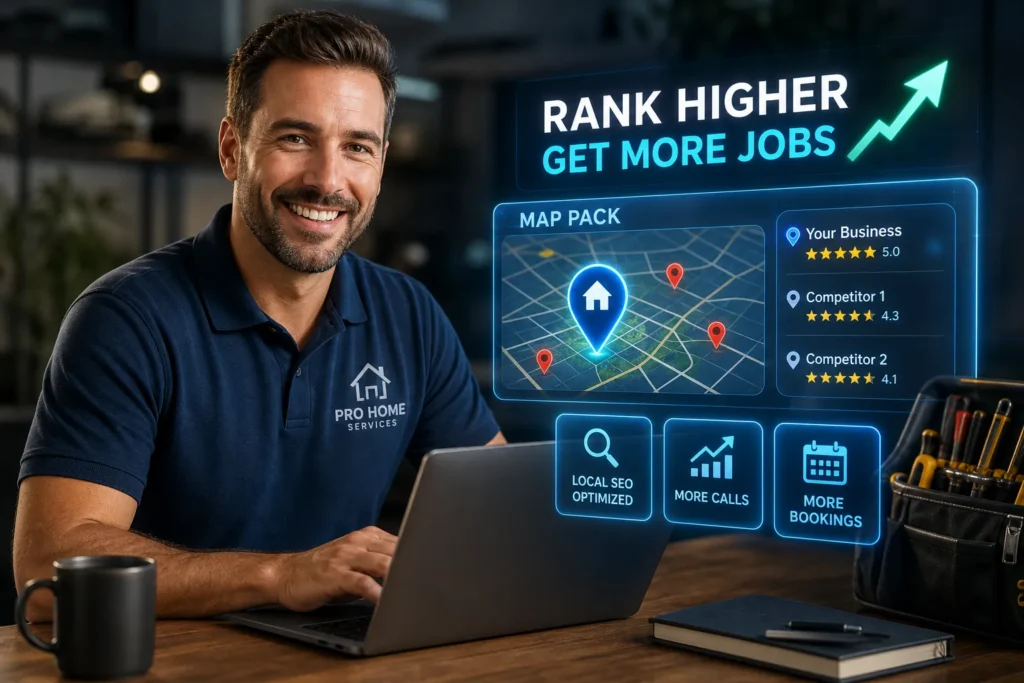
SEO for Home Services: How Contractors Win the Map Pack
Home service SEO is essential for contractors who want to generate more local leads and booked jobs. Success starts with optimizing your Google Business Profile, creating location-specific service pages, consistently earning customer reviews, maintaining accurate business citations, and tracking key performance metrics. By following a structured local SEO strategy, plumbers, HVAC contractors, electricians, roofers, and other service businesses can improve Map Pack rankings, increase visibility, and attract more high-intent customers.
When a homeowner’s pipe bursts, they grab their phone and type “plumber near me.” Three names appear in the Map Pack. The contractor in position one gets the call. The contractor in position four gets nothing, even if their work is better, their prices are fairer, and their reviews are glowing. Strong SEO for home services is what separates the contractor who gets that call from the one who never knew the lead existed. That’s the reality of local search in 2026, and it’s not changing anytime soon.
Map Pack position one captures roughly 32% of all local clicks. Position two gets 22%. Position three gets 15%. Every contractor below that competes for the remaining scraps split across dozens of organic results. The gap between showing up and not showing up translates directly into booked jobs per week, not website visits, not impressions. Actual revenue.
This guide walks through the full system: Google Business Profile optimization, service-area landing pages, review acquisition, citation building, and the KPIs that tell you whether any of it is working. The contractors winning local search right now aren’t doing anything mystical. They’re executing a specific, repeatable process, and some of them are doing it with the help of agencies that build exactly these campaigns every day.
Why SEO for home services works differently than other local businesses
Google ranks local results using three core pillars: relevance, distance, and prominence. Distance is partly fixed, Google knows where the searcher is standing. But relevance and prominence are entirely within your control, which means the Map Pack is a competition you can actually win with the right approach.
Service-area businesses (SABs) face a specific structural challenge. Unlike a restaurant or retail store, you don’t have a physical location that customers visit, which means Google can’t lean on storefront proximity as a strong credibility signal. The burden shifts to your service-area configuration, your website’s local pages, and your review profile. Contractors who understand this skip months of wasted effort chasing tactics built for brick-and-mortar businesses.
Home service searches are also high-intent and mobile-dominant in a way that most industries aren’t. The person searching “HVAC repair near me” at 9 PM in July isn’t browsing options. They’re calling the first credible result they see. That urgency means Map Pack visibility doesn’t just drive traffic, it drives same-day bookings. Every position you climb directly translates into calls you receive instead of calls your competitor receives.
SEO for home services: Google Business Profile optimization
Most contractor profiles are incomplete, miscategorized, or abandoned after the initial setup. A fully optimized GBP looks dramatically different from a basic one, and that gap shows up in rankings within 60 days of making serious changes.
Primary category and services section
Your primary category is the single most powerful signal in your profile. It should match your core revenue service exactly: “Plumber,” “HVAC Contractor,” “Roofing Contractor”, not “Home Improvement,” not “Contractor.” The more specific and accurate the match, the stronger the relevance signal. Secondary categories should reflect services you actually offer. Adding irrelevant ones dilutes your profile’s focus rather than broadening your reach.
The services section deserves more attention than most contractors give it. List specific offerings, not just trade umbrellas. “Tankless water heater installation,” “emergency drain cleaning,” and “AC tune-up” each target different search queries. Write short, natural descriptions for each service that mention what it solves and where you provide it. Complete your attributes, licensed, insured, veteran-owned, and similar, because they surface in filtered search results that competitors with incomplete profiles simply won’t appear in.
Photos, posts, and staying active
Google Posts expire after seven days, so weekly posting is the minimum cadence, not the goal. A photo of a completed job, a seasonal promotion, or a service reminder keeps your profile active and signals to Google that the business is current. Photos of your team, trucks, and finished work build trust with searchers before they ever call, and that trust influences whether a click becomes a conversation.
Service area configuration for SABs
One configuration step most SABs miss: if you operate from a home address with no public storefront, hide your address in the profile settings and configure your service areas correctly. Go to Edit profile, select Location, and turn off “Show business address to customers.” Then add the cities, ZIP codes, or regions you actually serve, Google allows up to 20 service areas. List only the areas where you genuinely take jobs. Padding the list with distant markets you don’t serve looks spammy and undermines your local relevance signals.
Building service-area landing pages for home services SEO
A single homepage can’t rank for “electrician in Austin” and “electrician in Round Rock” at the same time. Service-area landing pages solve this by giving Google location-specific signals tied to real service intent. Without them, you’re relying on your GBP alone to do work that requires website reinforcement.
The cleanest site structure for SABs is a hub-and-spoke model. A services hub links to individual service pages. A service areas hub links to individual city pages. Each city page links back to relevant service pages, and each service page links to the city pages where that service is available. This internal linking hierarchy tells Google how your content relates and keeps crawl equity flowing through your most commercially important pages. Pick one URL pattern, something like /services/city/ or /service-area/city/, and commit to it across the site.
A city page that only swaps the location name into boilerplate copy won’t rank, and it shouldn’t. Each page needs a strong H1 combining the service and the city, local proof in the form of project photos or neighborhood references, a list of services available in that specific market, a clear call-to-action with phone number or booking form, and FAQs that address local concerns. That depth is what separates a page Google trusts from a page Google ignores.
For schema, use LocalBusiness markup to represent your actual business entity and Service schema on individual service and city pages. Don’t create schema that implies a physical office in every city you serve, Google can detect those inconsistencies and they work against you. Schema should accurately describe the service relationship: your real business, serving a defined geographic area.
Review velocity: the ranking factor you can’t afford to ignore
Reviews account for roughly 20% of local pack ranking weight, and recency matters as much as volume. A contractor with 200 reviews and no new ones in six months is actively losing ground to a competitor with 40 reviews acquired steadily over the past year. The review profile Google rewards is a living signal, not a milestone you reach once and forget.
The best moment to ask is immediately after job completion, when satisfaction is at its peak. Send a direct link to your Google review page, not a link to your website, not instructions to “find us on Google.” Remove every step between the customer and the review box. A follow-up SMS 24 to 48 hours later for non-responders recovers a meaningful percentage of responses that would otherwise be lost.
Three workflow types fit different operation sizes. CRM-based automation through platforms like ServiceTitan, Housecall Pro, or Jobber triggers review requests automatically when a job closes. Dedicated review platforms like Podium, Birdeye, and NiceJob handle sequencing, follow-ups, and monitoring, NiceJob starts around $75/month and suits smaller teams that need review automation without the overhead of a full communication suite. For operations running five to ten jobs per week, a manual checklist where staff sends the review link as part of job close-out is often enough. The right tool is the one your team will use every single time, because consistency is what drives velocity.
Respond to every review, positive and negative, within 24 hours. Responses signal to Google that the profile is actively managed. For negative reviews, a calm and solution-oriented response does more to protect your reputation than silence or defensiveness. Future customers read how you handle problems just as closely as they read the review itself.
Citations and local links: the authority signals that break ties
Once your GBP and website foundation are solid, citations and backlinks become the tie-breakers in competitive markets. These are the prominence signals Google uses to confirm that your business is a real, established presence in the area, not just a profile someone created last Tuesday.
NAP stands for Name, Address, Phone number. For SABs, the address may be hidden from customers, but your business name and phone number need to match exactly across every directory. Inconsistencies between your GBP, website, Yelp listing, Angi profile, and Thumbtack page create conflicting signals that suppress rankings. For home service businesses specifically, the highest-priority directories include Google Business Profile, Bing Places, Apple Business Connect, Yelp, Angi, HomeAdvisor, and Thumbtack. The major data aggregators, Data Axle and Neustar Localeze, syndicate your information into dozens of downstream apps and maps, making them worth getting right early. Audit your top citations annually and fix discrepancies as they appear.
Local backlinks carry outsized weight in local search. Practical targets include local Chamber of Commerce directories, supplier or manufacturer partner pages, neighborhood association websites, and local news coverage of completed projects. Sponsoring a community event or joining a trade association often produces a link without a complex outreach effort. These don’t require a full-scale link-building campaign; they require systematic relationship-building in the communities you serve.
Tracking results and knowing when to bring in a local SEO partner
Running a local SEO for contractors campaign without tracking is expensive guessing. The metrics that tell you whether your efforts are translating into business are specific, and most of them are available for free through Google Search Console and your GBP dashboard.
The KPIs that matter most for home service contractors:
- Map Pack positionfor your core service and city queries
- GBP insights: calls, direction requests, and website clicks tracked as monthly trends
- Organic traffic to service and city pages via Google Search Console
- Conversion rate on city and service pages, measured by calls and form fills
- Review count and average rating tracked monthly against your main competitors
Position fluctuations week-to-week are normal and expected. What you’re watching is the trend across 60 to 90-day windows. A single bad week doesn’t mean the campaign is broken. A downward trend across three months means something needs to change.
A point arrives where the system is too large to manage alongside running a business. If you’re serving multiple cities, managing a team, and simultaneously juggling GBP updates, review requests, content production, citation cleanup, and link outreach, the opportunity cost of handling it yourself outweighs the savings. DM Tech Labs specializes in building customized local SEO campaigns for home service providers, with transparent KPI reporting and a process that extends well beyond basic GBP setup into full Map Pack optimization and campaign management. When evaluating any agency, ask for case studies from contractors in your specific trade. Look for proven experience with service-area businesses, reporting tied to real outcomes like local lead generation for contractors, and a clear explanation of what they’ll actually do each month, not just a list of deliverables that sound impressive without context.
The system that books jobs from search
The order matters. Start with your Google Business Profile, fix the category, complete the services section, configure your service areas, and establish a weekly posting routine. Then build or improve your service-area landing pages with genuine local proof and proper internal linking. Then put a review acquisition workflow in place that runs automatically every time a job closes. Then clean up your citations and begin building local backlinks. Track progress every 30 days against the KPIs that tie to actual revenue.
The contractors booking jobs from local search right now aren’t doing anything magical. They’re executing this system consistently, month after month, while their competitors update their GBP once and wait. SEO for HVAC contractors, plumbers, electricians, and every other home service trade rewards the business that stays in the game long-term, far more than the one who makes a single optimized change and expects results overnight.
Whether you’re building this yourself or working with a partner, effective SEO for home services starts with one concrete action: audit your GBP today and fix what’s incomplete. Every improvement you make compounds into stronger rankings, more Map Pack visibility, and more booked jobs. That’s the system. Start there.
Frequently Asked Questions (FAQs)
1. What is SEO for home services?
SEO for home services is the process of improving your online visibility so your business appears higher in Google Search and the Local Map Pack when customers search for services like plumbing, HVAC repair, roofing, or electrical work.
2. Why is Google Business Profile important for contractors?
Google Business Profile is one of the strongest local ranking factors. A complete and optimized profile helps your business appear in local searches, increases credibility, and drives more calls, website visits, and service bookings.
3. How long does local SEO take to show results?
Most businesses begin seeing improvements within 2–4 months, while significant gains in rankings, traffic, and leads typically take 3–6 months. Highly competitive markets may require 6–12 months of consistent optimization.
4. Do I need separate pages for every service area?
Yes. Creating unique service-area landing pages for each city or region helps Google understand where you provide services and improves your chances of ranking for location-specific searches.
5. How important are customer reviews for local SEO?
Reviews are a major local ranking factor. Consistently earning new, high-quality reviews and responding to them promptly helps improve both search visibility and customer trust.
6. What are local citations, and why do they matter?
Local citations are online listings that include your business name, phone number, and other contact details. Consistent information across directories like Google, Yelp, Angi, and Apple Business Connect strengthens your local SEO.
7. Which KPIs should home service businesses track?
Monitor key metrics such as Local Map Pack rankings, Google Business Profile calls and clicks, organic traffic, conversion rates, review growth, average rating, and qualified leads generated from search.
8. Can I do home service SEO myself?
Yes, many business owners can manage basic tasks like optimizing their Google Business Profile, collecting reviews, and updating website content. However, growing across multiple service areas often benefits from professional SEO support.
9. What are the biggest local SEO mistakes contractors make?
Common mistakes include incomplete Google Business Profiles, duplicate or thin location pages, inconsistent business information across directories, ignoring customer reviews, and failing to track SEO performance.
10. Is SEO worth it for plumbers, HVAC companies, electricians, and roofers?
Absolutely. Local SEO helps home service businesses attract customers actively searching for their services, leading to more qualified leads, higher booking rates, and sustainable long-term business growth.
{ "@context": "https://schema.org", "@type": "Article", "datePublished": "2026-08-01T19:09:40.918Z", "dateModified": "2026-08-01T19:09:40.932Z", "headline": "SEO for Home Services: How Contractors Win the Map Pack", "description": "Master SEO for home services with strategies that get contractors into the Map Pack, generate reviews, and book more local jobs. Start with this guide.", "publisher": { "@type": "Organization", "name": "DM Tech Labs" }, "mainEntityOfPage": { "@type": "WebPage", "@id": "https://dmtechlabs.us/blog/seo-for-home-services/" }, "image": [ "https://dmtechlabs.us/wp-content/uploads/2026/08/seo-for-home-services-how-contractors-win-the-map-pack-1785610993052.webp" ], "url": "https://dmtechlabs.us/blog/seo-for-home-services/" }
